
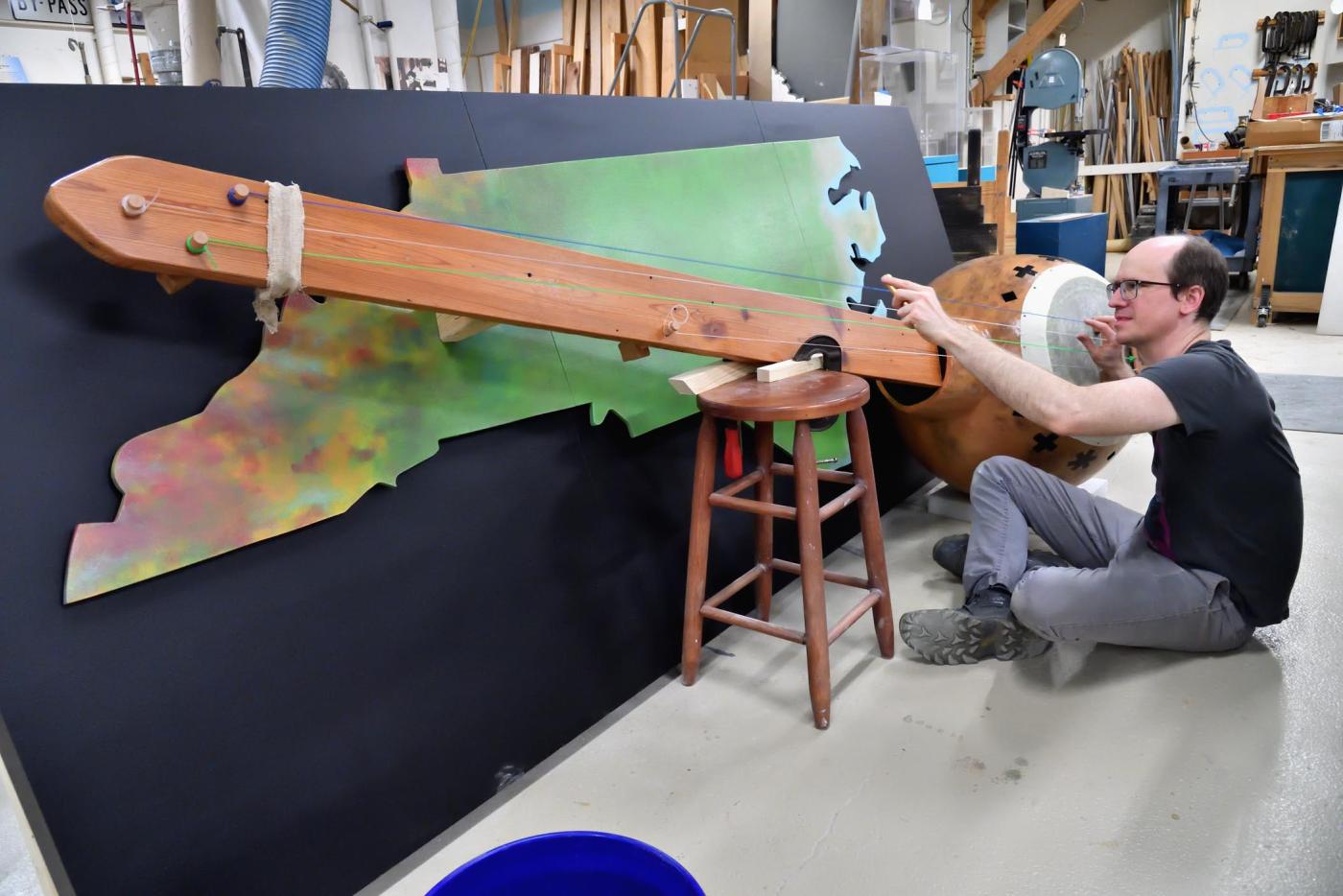
The modern banjo is descended from instruments played in 17th-century North America and the Caribbean by enslaved people taken from West and Central Africa. Banjos with fingerboards and tuning pegs were used in the Caribbean in the early 1600s, according to Dena J. Epstein’s article “The Folk Banjo.”
Before the Civil War, many enslaved people played the banjo. They taught each other to play, as well as their White enslavers, Epstein wrote. From there, the banjo spread throughout the South, finding a place in many musical genres, including bluegrass, blues, and folk. Popular banjoists from North Carolina include Earl Scruggs from Cleveland County and Libba Cotten from Carrboro, both of whom have styles named after them.
In early 2025, the NC Music Office requested an oversized banjo interactive for the inaugural Biscuits and Banjos festival in Durham. This festival from Grammy-winning Rhiannon Giddens celebrated African American folk music in North Carolina. Giddens plays banjo too.
The primary goals of our build were to emphasize the historical Afro-Caribbean roots of the banjo while providing a community chalkboard surface for festival attendees. As musicians, my teammate Trent Bowles and I wanted this to be a functional nine-foot-long musical instrument.
For our larger-than-life creation, we referenced images of a gourd banjo built as a luthier’s interpretation of one depicted in the watercolor titled Music and Dance in Beaufort County. Dated circa 1785, this is one of the earliest surviving representations of a banjo-like musical instrument in the Carolinas. While gourd instruments in the Americas have an even deeper African diasporic history than this, visual representation remains sparse.
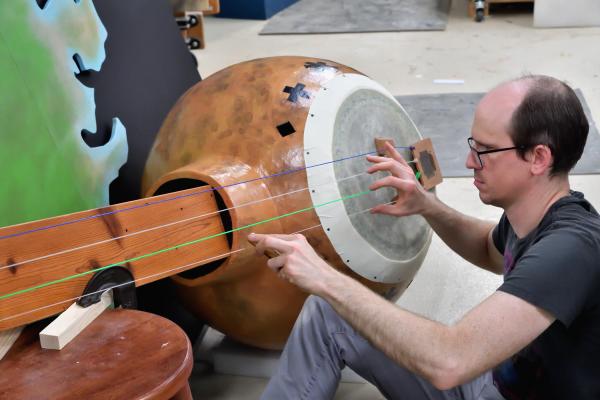
To build the banjo, we used materials on hand in our exhibit shop like dimensional lumber, plywood, foam, fabric, and paint. For acoustic purposes, the gourd component needed to be hollow and lightweight yet robust enough to withstand string tension and public interaction. Our engineering solution for a nearly spherical, hollow, and strong form was to construct a soccer ball from thin mitered plywood panels.
This was covered with foam, rounded over, hardened with glue-soaked canvas, and then painted.
The instrument neck is built like an actual banjo spike, but on a much larger scale. It is made from recycled heartwood pine flooring laminated onto a two by four stud and carved down to shape.
The friction tuning pegs, bridge, and tailpiece are all hand carved maple. The four strings are different gauges of weed-eater line and other nylon monofilament, and the banjo head is a stretched goatskin.
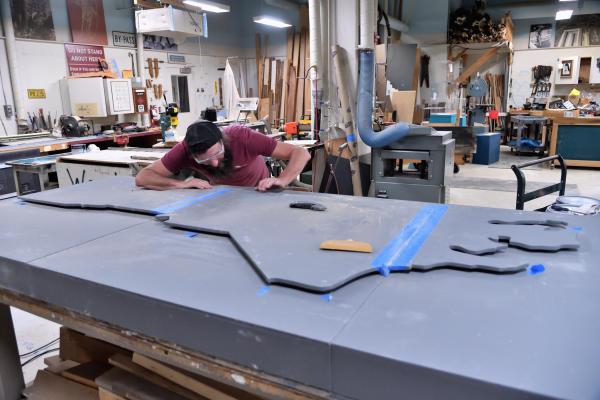
This big banjo was then affixed to a backboard and a 10-foot self-supporting base adorned with a geographic cutout of North Carolina.
After the festival, the banjo became part of the North Carolina Museum of History’s traveling exhibits. It has been on display at the State Archives of North Carolina building and the ABC 11 Studios in Raleigh.
____________________________________________________________________________________
This article was originally published in Circa Magazine, the museum’s biannual publication made possible through the generous support of the North Carolina Museum of History Foundation.