
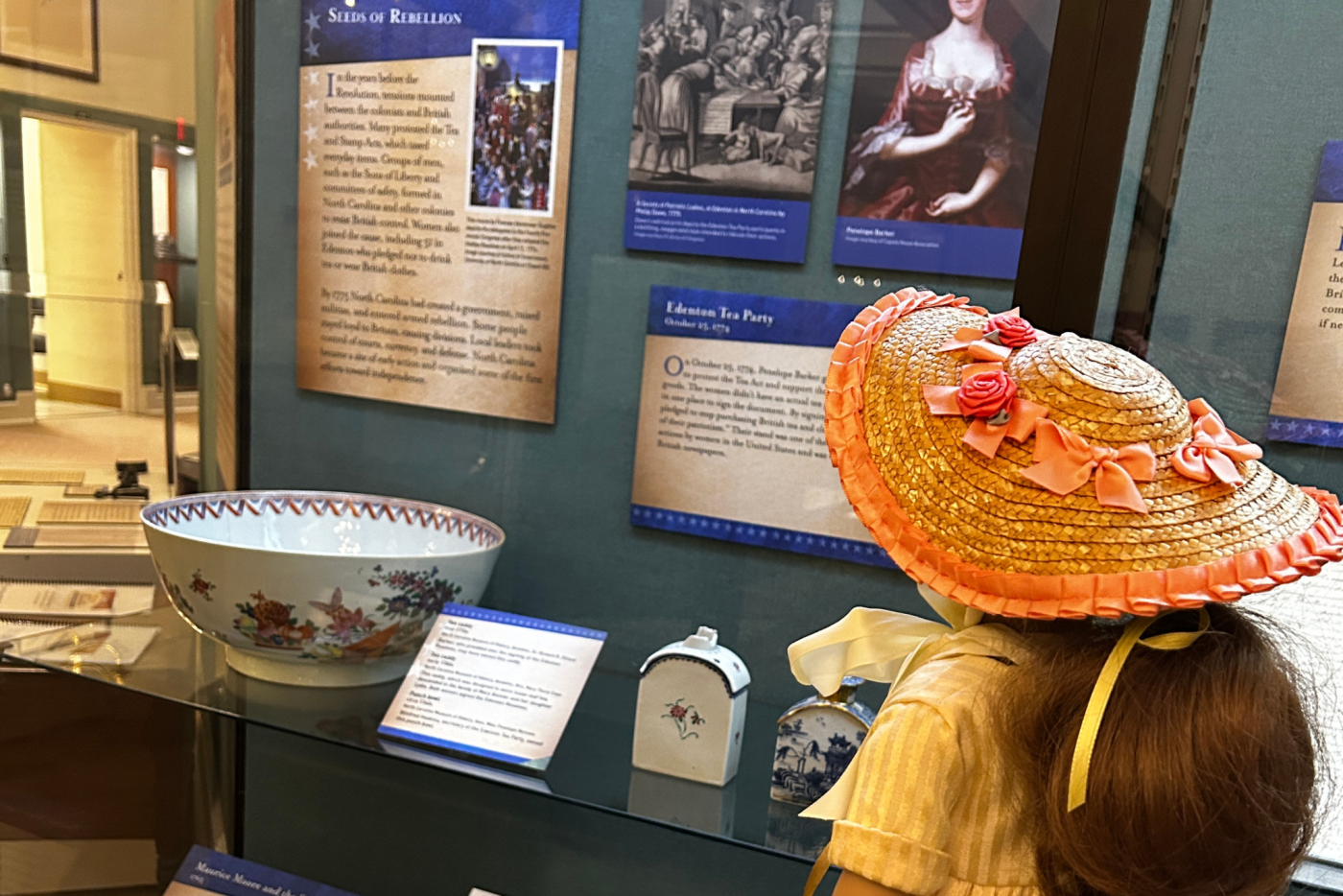
Returning to Felicity’s Story
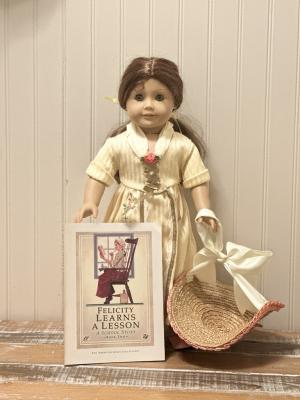
For the third installment in our rereading of the American Girl Felicity series, we picked up Felicity Learns a Lesson. In this book, Felicity starts formal lessons with two other local girls who have just moved to the Virginia Colony from England: Elizabeth and Annabelle Cole. Felicity expects to find the lessons dull, but she soon enjoys learning elegant penmanship, fancy stitchery, formal dancing, and the proper way to serve tea.
One of the joys of rereading these books is discovering how fun they still are. The book opens with Felicity hiding outside because she does not want to spend a hot day making apple butter in front of a fire. Same, girl! The beauty regimens of the past are just as entertaining. Felicity’s mother wants to make sure she looks the way the daughter of an important merchant should look. Washing her face in buttermilk, bleaching her freckles with lemon juice, and styling her hair with a pomade made of cinnamon and hog’s fat are among the things Felicity does to prepare for school. Thankfully, back-to-school prep no longer leaves you smelling like a vat of bacon.
Felicity’s story highlights how different girls’ educations were from boys’ educations. Felicity thinks she would rather go to a college or university like gentlemen, studying Greek and Latin and debating philosophy, or learn a trade like an apprentice. Instead, her parents want her to learn how to be a proper young lady. She needs to learn how to run a household. Her mother tells her that her own mother taught her these skills and that, one day, Felicity will teach her daughter.
“A notable housewife runs her household smoothly so that everyone in it is happy and healthy. Her life is private and quiet. She is content in doing things for her family,” her mother said.
These words fill Felicity with dread as she waits for her lessons to start. Enter Miss Manderly. Despite her misgivings about her ladylike lessons, Felicity finds that she greatly enjoys learning the fine art of serving tea. She notes many times that she hopes to be as graceful and elegant as her teacher.
This particular book focuses on the rising tensions between Patriots and Loyalists. Annabelle calls Felicity’s family traitors during their tea lesson because they support the colonists who participated in the Boston Tea Party and have signed an agreement to no longer sell tea in the family’s shop. Felicity feels conflicted and confused. She thinks the adults around her are grumbling over “a few pence more for tea.” Her mother warns her that this talk will lead to something more, something that will end friendships and divide families.
Felicity fears that her new friendship with Elizabeth will end if she refuses to drink tea or sew a red crown on her sampler during their lessons. Ultimately, Felicity decides that her family is right to oppose the crown. She gracefully turns over her teacup and declares that she will have no tea.
Artifacts that Help Tell the Story
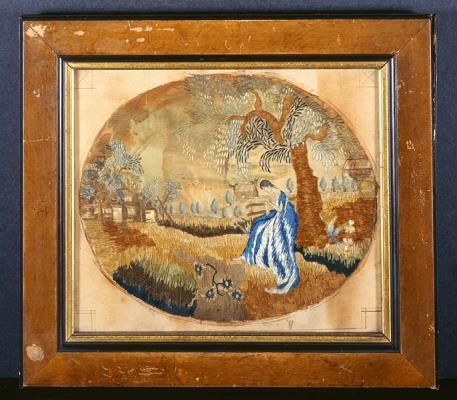
Felicity’s lessons may take place in Virginia, but upper-class girls in colonial North Carolina would have learned many of the same skills. A needlework picture in the museum’s collection offers one example. It was made between about 1780 and 1790 by Catherine “Kitty” Kenan, who was born in Duplin County in 1772.
There were very few schools for girls in North Carolina at the time. Girls from families who could afford an education often studied with an instructor or tutor in a private home, much as Felicity studies with Miss Manderly. Alongside reading, writing, and other academic subjects, they practiced needlework and the household skills expected of young women. Samplers and decorative embroideries were common projects. The face and hands of the central figure on Kenan’s embroidery were drawn in, a common way to add fine details to embroidered figures.
Felicity’s own embroidery becomes an important part of the story when she must decide what to stitch during her lessons. Annabelle sews a red crown to show her loyalty to the king, while Felicity chooses a red cardinal instead. Something that might look like a simple school project becomes a way for both girls to express where their families stand as tensions rise in the colonies.
Those tensions also transform another part of Felicity’s education: learning how to serve tea. At a time when girls and women had limited opportunities to participate openly in politics, choices made in classrooms and around tea tables could still make a statement.
Edenton Tea Party
Felicity Learns a Lesson focuses on Felicity as she navigates big changes in Williamsburg. This is true for all of the books in the series. But readers need to remember that Felicity’s thoughts and actions were influenced by her place within Williamsburg. She is the daughter of a merchant. Her family enslaves two people, Marcus and Rose. She also takes lessons from Miss Manderly to learn how to become a gentlewoman.
It must have been hard for Felicity to take a stand and decline tea during her lesson with Miss Manderly. But she had support from her family. Her father had stopped selling tea in his shop! Felicity could take an action that she felt confident making. Readers should also remember that she had the privilege to act decisively.
Felicity’s defiant act has similarities to North Carolina’s Revolutionary history. In 1774 a group of women in and around Edenton agreed to protest the Tea Act. The act was passed by the British Parliament in 1773. The act gave the East India Company a monopoly on tea in the colonies, and colonists protested it. They thought it was unfair and an example of what many believed to be Britain’s abuse of power.
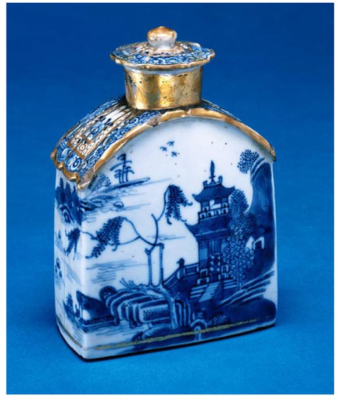
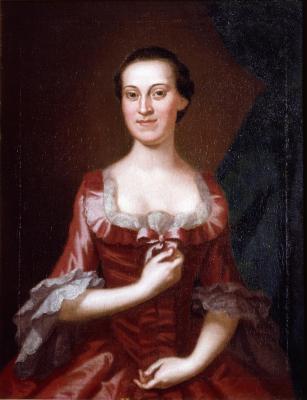
Penelope Barker was one of the 51 women who protested the Tea Act by writing and signing a resolution. By signing this document, the women said they would boycott British goods like tea. Many of these women were from wealthy families. Many, like Penelope Barker, were enslavers. Many were affected by the act because their husbands and families owned businesses. These women had power and privilege that other women at the time did not have, but they used that power and privilege to sign the resolution.
The efforts of the women who protested the Tea Act became known as the Edenton Tea Party. But it wasn’t a party. It was a carefully planned act to support the Patriot cause, and it was one of the first organized political efforts by women in America. But we must remember the privileges afforded to these women that allowed them to organize and act.
Choosing Sides
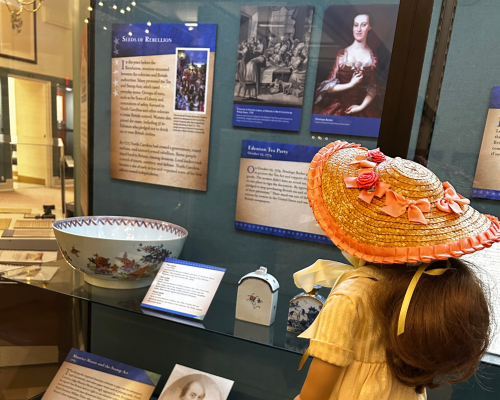
Felicity spends this book learning many lessons. She works on a sampler. She practices pouring tea. But she also learns how to hold firm to what she believes is just. Like many lessons, it wasn’t necessarily easy for Felicity to learn. It took time and patience.
Felicity aligns herself with the Patriot cause. She refuses to drink tea, supporting protests against British acts that upset many colonists. But she also associates with her friend Elizabeth, a girl from England whose family are Loyalists.
Felicity holds many conflicting emotions about her views on British rule and her relationship with Elizabeth. But, as her mother reminds her, “You must be well-mannered but follow your heart. You must be polite but do what you think is right.” Felicity does just that by taking her lessons to heart and staying true to herself.