
A Decade of Revolution
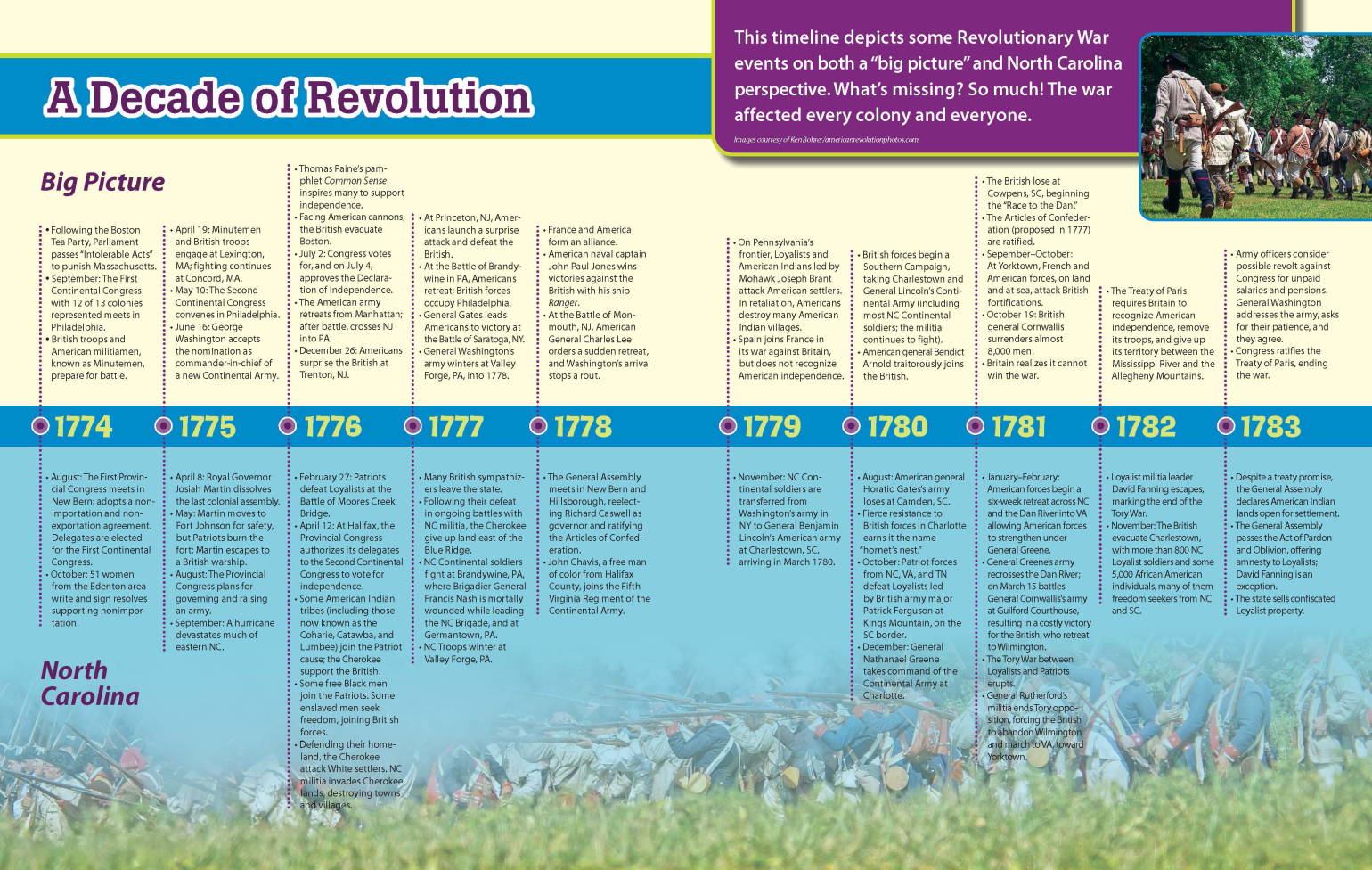
This timeline depicts some Revolutionary War events on both a “big picture” and North Carolina perspective. What's missing? So much! The war affected every colony and everyone.
Images courtesy of Ken Bohrer/americanrevolutionphotos.com.
Big Picture
1774
- Following the Boston Tea Party, Parliament passes “Intolerable Acts” to punish Massachusetts.
- September: The First Continental Congress with 12 of 13 colonies represented meets in Philadelphia.
- British troops and American militiamen, known as Minutemen, prepare for battle.
North Carolina
1774
- August: The First Provincial Congress meets in New Bern; adopts a nonimportation and nonexportation agreement. Delegates are elected for the First Continental Congress.
- October: 51 women from the Edenton area write and sign resolves supporting nonimportation.
Big Picture
1775
- April 19: Minutemen and British troops engage at Lexington, MA; fighting continues at Concord, MA.
- May 10: The Second Continental Congress convenes in Philadelphia.
- June 16: George Washington accepts the nomination as commander-in-chief of a new Continental Army.
North Carolina
1775
- April 8: Royal Governor Josiah Martin dissolves the last colonial assembly. May: Moves to Fort Johnson for safety, but Patriots burn the fort; Martin escapes to a British warship.
- August: The Provincial Congress plans for governing and raising an army.
- September: A hurricane devastates much of eastern NC.
Big Picture
1776
- Thomas Paine’s pamphlet Common Sense inspires many to support independence.
- Facing American cannons, the British evacuate Boston.
- July 2: Congress votes for, and on July 4, approves the Declaration of Independence.
- The American army retreats from Manhattan; after battle, crosses NJ into PA.
- December 26: Americans surprise the British at Trenton, NJ.
North Carolina
1776
- February 27: Patriots defeat Loyalists at the Battle of Moores Creek Bridge.
- April 12: At Halifax, the Provincial authorizes its delegates to be NC the first colony authorizing its delegates to the Second Continental Congress to vote for independence.
- Some American Indian tribes (including those now known as the Coharie, Catawba, and Lumbee) join the Patriot cause; the Cherokee support the British.
- Some free Black men join the Patriots. Some enslaved men seek freedom, joining British forces. Defending their homeland, the Cherokee attack White settlers. NC militia invades Cherokee lands, destroying towns and villages.
Big Picture
1777
- At Princeton, NJ, Americans launch a surprise attack and defeat the British.
- At the Battle of Brandywine in PA, Americans retreat, and British forces occupy Philadelphia.
- General Gates leads Americans to victory at the battle of Saratoga, NY.
- General Washington’s army winters at Valley Forge, PA, into 1778.
North Carolina
1777
- Many British sympathizers leave the state.
- Following their defeat in ongoing battles with NC militia, the Cherokee give up land east of the Blue Ridge.
- NC Continental soldiers fight at Brandywine, PA, where Brigadier General Francis Nash is mortally wounded while leading the NC Brigade, and at Germantown, PA.
- NC Troops winter at Valley Forge, PA.
Big Picture
1778
- France and America form an alliance.
- American naval Captain John Paul Jones wins victories against the British with his ship Ranger.
- At the Battle of Monmouth, NJ, American General Charles Lee orders a sudden retreat, and Washington's arrival stops a rout.
North Carolina
1778
- The General Assembly meets in New Bern and Hillsborough, reelecting Richard Caswell as governor and ratifying the Articles of Confederation.
- John Chavis, a free man of color from Halifax County, joins the 5th Virginia Regiment of the Continental Army.
Big Picture
1779
- On Pennsylvania’s frontier, Loyalists and American Indians led by Mohawk Joseph Brant attack American settlers. In retaliation, Americans destroy many American Indian villages.
- Spain joins France in its war against Britain but does not recognize American independence.
North Carolina
1779
- November: NC Continental soldiers are transferred from Washington’s army in NY to General Benjamin Lincoln’s American army at Charlestown, SC, arriving in March 1780.
Big Picture
1780
- British forces begin a Southern Campaign, taking Charlestown and General Lincoln’s Continental army (including most NC Continental soldiers; the militia continues to fight).
- American general Bendict Arnold traitorously joins the British.
North Carolina
1780
- August: American general Horatio Gates’s army loses at Camden, SC.
- Fierce resistance to British forces in Charlotte earns it the name “hornet’s nest.”
- October: Patriot forces from NC, VA, and TN defeat Loyalists led by British army Major Patrick Ferguson at Kings Mountain, on the SC border.
- December: General Nathanael Greene takes command of the Continental Army at Charlotte.
Big Picture
1781
- The British lose at Cowpens, SC, beginning the “Race to the Dan.”
- The Articles of Confederation (proposed in 1777) are ratified.
- September–October: At Yorktown, French and American forces, on land and at sea, attack British fortifications.
- October 19: British general Cornwallis surrenders almost 8,000 men.
- Britain realizes it cannot win the war.
North Carolina
1781
- January–February: American forces begin a six-week retreat across NC and the Dan River into VA, allowing American forces to resupply and strengthen under General Greene.
- General Greene’s army recrosses the Dan River; on March 15, battles General Cornwallis’s army at Guilford Courthouse, resulting in a costly victory for the British, who retreat to Wilmington.
- The Tory War between Loyalists and Patriots erupts.
- General Rutherford’s militia ends Tory opposition, forcing the British to abandon Wilmington and march to Virginia, toward Yorktown.
Big Picture
1782
- The Treaty of Paris requires Britain to recognize American independence, remove its troops, and give up its territory between the Mississippi River and the Allegheny Mountains.
North Carolina
1782
- The Treaty of Paris requires Britain to recognize American independence, remove its troops, and give up its territory between the Mississippi River and the Allegheny Mountains.
- Loyalist militia leader David Fanning escapes, marking the end of the Tory War.
- November: The British evacuate Charlestown, with more than 800 NC Loyalist soldiers and some 5,000 African American individuals, many of them freedom seekers from NC and SC.
Big Picture
1783
- Army officers consider possible revolt against Congress for unpaid salaries and pensions. General Washington addresses the army, asks for their patience, and they agree.
- Congress ratifies the Treaty of Paris, ending the war.
North Carolina
1783
- Despite a treaty promise, the General Assembly declares American Indian lands open for settlement.
- The General Assembly passes the Act of Pardon and Oblivion, offering amnesty to Loyalists; David Fanning is an exception.
- The state sells confiscated Loyalist property.