
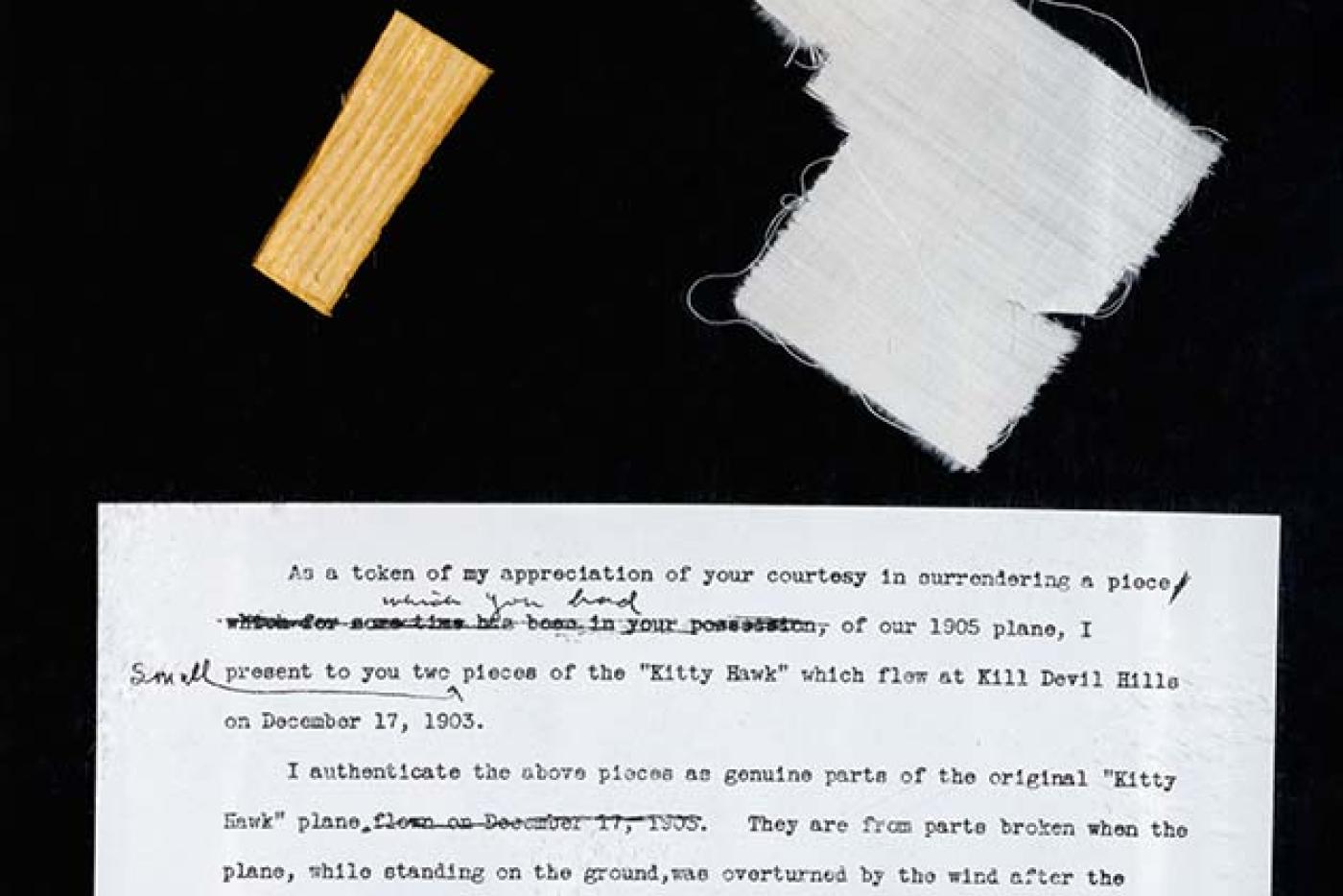
Wilbur and Orville Wright dreamed big and believed in their mission of solving “the flying problem,” but their impact would be even larger than they imagined. The North Carolina Museum of History received two fragments of the brothers’ first successful airplane from Orville in 1948. These fragments were once taken into space and orbited the Earth 110 times to honor the brothers’ contributions to aviation!
1903–1912: The Origins
December 17, 2025, will mark 122 years since the Wright brothers completed the world’s first heavier-than-air, engine-powered, pilot-controlled flight in an isolated area outside of Kitty Hawk, which was later incorporated as Kill Devil Hills. The brothers chose this spot due to its secluded nature, soft sands, and high wind speeds. They wanted to test their new machine away from the prying eyes of the press and competitors who would take any chance to claim the title themselves.
Incidentally, this date also marks 122 years since the original aircraft was last flown. Heavy wind gusts severely damaged the flyer after four successful flights that day. Known as the Wright Flyer or Kitty Hawk, its mangled wreckage was shipped back to the brothers’ home in Dayton, Ohio. It would not be restored for display until 1916, when it was loaned to the Massachusetts Institute of Technology.
In the meantime, the brothers continued to advance their machinery and test new airplanes in the same Kill Devil Hills area. The North Carolina Museum of History—or the Hall of History as it was known at the time—received its first Wright brothers artifact from Wilbur. He donated a piece of the Wright Flyer III from 1905 sometime after the plane’s crash during one of its test flights in 1908. Wilbur passed away a few years later in 1912 from complications of an illness.
1946–1950: The Artifact Switch
For the next 30 years, Orville conducted countless test flights, business contracts, international negotiations, and legal battles. The achievements of the Wright brothers remained central to the advancement of the aviation industry during this time.
Edwards A. Deeds, a friend of the Wright brothers, founded and funded Carillon Historical Park in Dayton, Ohio, in 1940. This park was built to highlight American achievements in transportation and industrial technology. The park’s scope and offerings grew over the decade, and in 1946, Deeds convinced Orville to restore the Wright Flyer III for display. Much of the aircraft had been held in the basement of the Berkshire Museum in Massachusetts. Other pieces had to be tracked down over the next few years, as they had been taken as souvenirs.
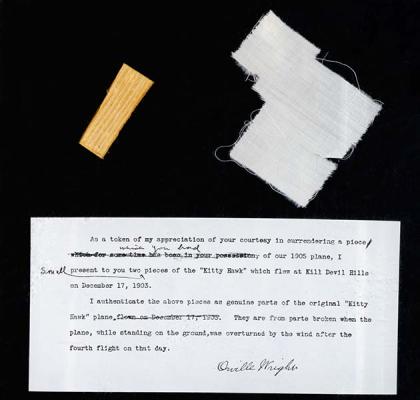
This also meant that Orville had to ask the North Carolina Museum of History for the piece that Wilbur had originally donated. Orville understood the importance of this object to the museum’s collection, so he offered a generous trade—the museum would trade the piece of the Wright Flyer III for a fragment of the first Wright Flyer’s wooden frame and a scrap of its silk wings. The museum accepted this trade, as well as a note of authentication signed by Orville. Unfortunately, Orville passed in January of 1948, so he would not see the fully restored Wright Flyer III displayed in Carillon Historical Park in 1950.
1985: The Space Mission
Although they were not around to witness space exploration missions conducted by NASA, the Wright brothers’ impact on the aviation industry was not to be forgotten. This rang especially true in 1985.
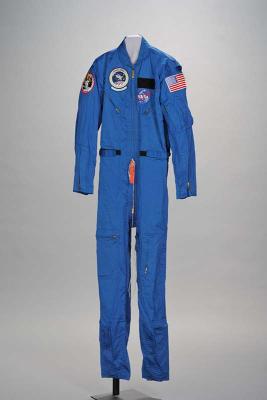
Dr. William E. Thornton was a NASA astronaut, UNC Medical School alum, commissioned US Air Force officer, and native North Carolinian from the town of Faison. He received permission from NCMH to take the fragments of the Wright Flyer into space. Thornton stored the artifact in his personal locker on the Challenger space shuttle during Mission STS-51-B, which orbited Earth 110 times from April 29, 1985, to May 6, 1985.
Thornton was a scientist and mission specialist who studied the effects of space travel on animals and his fellow astronauts. This mission was his second and final time traveling into space. Thornton recognized the larger meaning and legacy of his work, and he wanted to honor those who came before him who made his career possible. In that same vein, Thornton donated many of his items to NCMH in 2017. Now, his items are forever connected to the lasting legacy of the Wright brothers.